ROIO: audio and/or video recording of a performance that was not officially released by the artist, or under other legal authority.
Soundboards, Quality Audience Recordings, FM Broadcasts, Concert Videos and Out of Print Recordings.
The more-jazz-than-rock fusion band Isotope may have not had the longest career, but they played an integral part in the Canterbury Scene with some of its key players spending time in the band. Guitarist Gary Boyle had been playing in Dusty Springfield's band for a couple of years before he caught the prog rock bug. He got it while playing in Brian Auger & the Trinity and afterward decided to go back to school to further his musical studies. After leaving school he played with Keith Tippett and Mike Gibbs, but it was in Stomu Yamash'ta's East West band that he met drummer Nigel Morris. The two formed Isotope in 1973 and soon bassist Jeff Clyne was onboard. The band's self-titled debut appeared in 1974, followed soon after by Clyne's departure. Former East West bassist Hugh Hopper joined the band in March of 1974, the same year Boyle was to place third in the category of "Best British Guitarists" in Melody Maker's reader poll. Keyboardist Laurence Scott was added to the band for 1975's Illusion and the band gathered more fans on a U.K. tour supporting Gong. Hopper and Scott left the band and were replaced by bassist Dan K. Brown and two keyboardists -- Frank Roberts and Zoe Kronberger -- for 1976's Deep End. Management and record company struggles caused the band to break up in 1977. The See for Miles label reissued the band's albums in the mid-'90s and Hux unearthed two radio sessions for 2004's Live at the BBC.
~ David Jeffries, AMG
Guitarist Gary Boyle leads the charge here, along with famed "Soft Machine" bassist Hugh Hopper; appearing on the "Illusion" album, and drummer Nigel Morris, serving as the standouts. As keyboardist Laurence Scott's ("Isotope") and Brian Miller ("Illusion") render flashy electric piano riffs to augment this band's upfront jazz-rock approach. Elements of John McLaughlin's "Mahavishnu Orchestra" are imminent here, as this group navigates tricky time signatures, spearheaded by Boyle's speedy, fuzz-toned licks and Morris' polyrhythmic timekeeping. In addition, "Isotope's" line of attack consisted of memorably melodic hooks and fierce soloing endeavors. This recording kicks major ASS!!
#1-3: recorded live at The Newport Jazz Festival, Newport, RI, July 5, 1969 #4-9: recorded live at the Isle of Wight on August 29, 1970 Mastered at Battery Studios, New York City
Recorded July 5, 1969 at NEWPORT JAZZ FESTIVAL including the first ever professionally recorded live version of "Miles Runs The Voodoo Down" and the first known recording of the revamped electric version of "Sanctuary" just over a month before Miles went into the studio to record what would become his fastestselling album of all time, BITCHES BREW. Fast-forward one year ... August 1970, ISLE OF WIGHT FESTIVAL in the U.K. where Miles is playing with a much more electric, rock-oriented sound in front of 600,000 people! This incredible full set includes the title track "Bitches Brew" and "Spanish Key" played by Davis's remarkable all-star group captured live at the peak of its powers.
Recorded live at The Newport Jazz Festival, Newport, RI, July 5, 1969 1. Miles Runs The Voodoo Down 10:26 2. Sanctuary 3:58 3. It's About That Time / The Theme 9:40
Recorded live at the Isle of Wight on August 29, 1970 4. Directions 7:30 5. Bitches Brew 10:09 6. It's About That Time 6:17 7. Sanctuary 1:10 8. Spanish Key 8:15 9. The Theme 2:10
Trumpet – Miles Davis Alto Saxophone, Soprano Saxophone – Gary Bartz (tracks: 4 to 9) Bass – Dave Holland Drums – Jack DeJohnette Electric Piano – Chick Corea Organ – Keith Jarrett (tracks: 4 to 9) Percussion – Airto Moreira (tracks: 4 to 9)
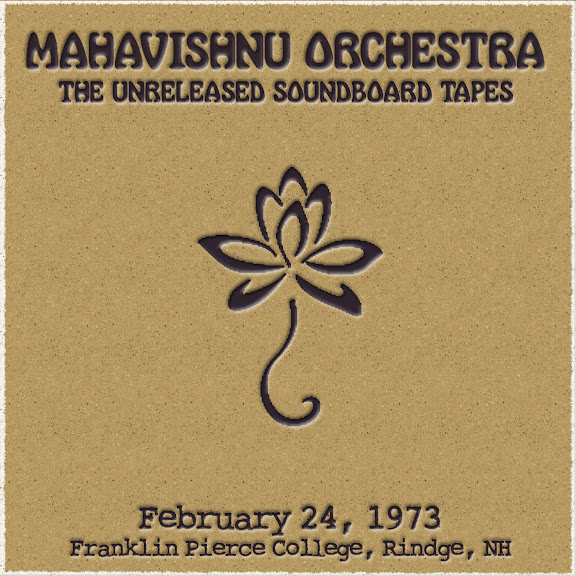
Mahavishnu Orchestra Franklin Pierce College
February 24, 1973
Rindge, NH.
Soundboard @320
Set List: 01. Meeting of the Spirits 12:02
02. Open Country Joy 8:57
03. Hope / Awakening 19:42
04. Miles Beyond 11:14
Billy Cobham - drums
Jerry Goodman - violin
Jan Hammer - keyboards
Rick Laird - bass
John McLaughlin - guitar
**Original Notes**
The initial classic lineup of the Mahavishnu Orchestra lasted less than three years and only released two studio albums and one live recording during this era, but these recordings had a profound effect, redefining the jazz/rock fusion movement. Combining the improvisational elements of jazz with the volume and energy of rock music, the group created music that was often intricate and complex, performed by musicians whose virtuosity thrilled audiences, musicians, and critics alike.
By early 1973, the Mahavishnu Orchestra had firmly established their reputation and with little over a year of live performances behind them, they had become one of the most exciting bands on the planet. This partial February 1973 performance captures the group following the release of Birds of Fire and several months before they recorded the live album, Between Nothingness and Eternity. Recorded at Franklin Pierce College in New Hampshire, this is yet another stellar example of the band's blazing energy and fluid virtuosity. Now an established headliner, the Mahavishnu Orchestra had more time onstage and they seized that opportunity to explore in greater depth. This set captures the group as they were diversifying the onstage repertoire and extending their improvisational approach.
The performance begins with the pairing of the Inner Mounting Flame's leadoff track, "Meeting Of The Spirits," with "Open Country Joy" from Birds Of Fire. While both remain aligned with the album arrangements, here they feature extended solos, often explosive and pummeling in their ferocity. Open Country Joy," a strutting, gradually intensifying urban blues is perhaps the least complex composition the classic lineup ever played, vacillating between a laidback county feel and frenzied rocking power.
Although brief, "Hope" unfolds in an elegant, magisterial way, before Cobham suddenly blasts off into "Awakening." This too has moments of frightening intensity and the telepathy between these musicians is functioning at an astounding level. Hammer takes an impressive solo here, simultaneously playing bluesy Fender Rhodes with gurgling mini-moog embellishments. It eventually becomes a duel between McLaughlin and Cobham, and this is unison playing at its most astonishing. McLaughlin doesn't let up for a second, interjecting an endless barrage of ideas, while Cobham often does more with a hi-hat and snare drum than most drummers are capable of with an entire kit.
The recording concludes with McLaughlin's tribute to Miles Davis, "Miles Beyond," with the group again displaying breathtaking improvisational abilities within a funkier context. Dominated by Hammer, who offers a barrage of demented sounds from his keyboards, this also features Jerry Goodman propelling the basic groove with McLaughlin, Laird, and Cobham providing rhythmic punctuations and accents.
Every concert from this era of Mahavishnu Orchestra is astonishing to some degree and this is no exception, featuring the original lineup at the pinnacle of their powers.


 LOOKING FOR SOMETHING??